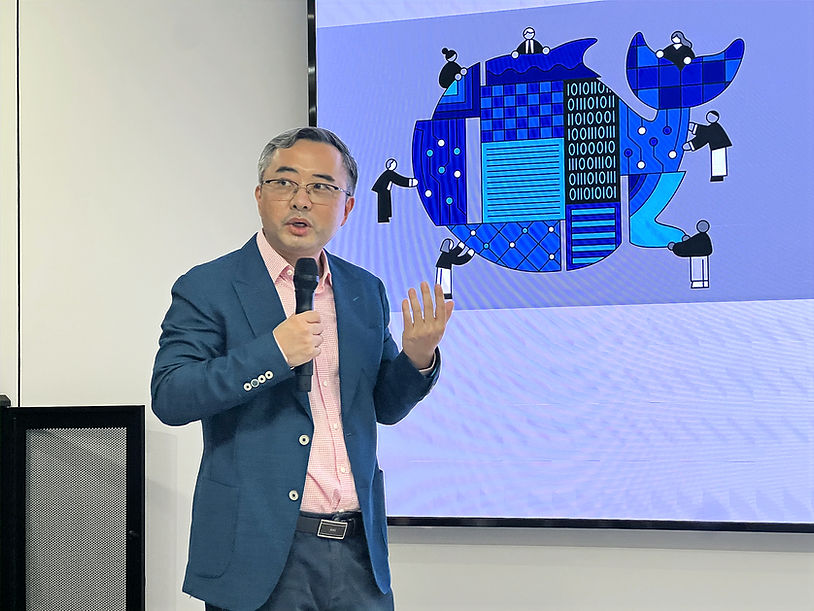
Wu Chen, a journalist, author, and former Managing Director of The Economist Global Business Review, believes the geopolitical story of the coming decades will center on two powers: the United States and China.
“The whole global order constructed by the United States after World War II is now in Tetris,” he told students in the Global Business Journalism program's Hot Topics course on September 22, describing a system shifting piece by piece but no longer stable.
The China-U.S. economic relationship, once interdependent, has fractured. The United States, Wu said, remains the champion of breakthroughs, “from zero to one,” like the leap that produced ChatGPT. China, by contrast, thrives at scaling innovations “from one to 100.”
Governance also reflects these contrasts.
“In China, engineers govern. In the United States, it’s lawyers, and that leads to gridlock,” he said.
Wu argued that lawyers are the one that “couldn't get things done," contrasting sharply with China's engineer-driven governance, which executes projects and builds things rapidly.
Financial dynamics are shifting too. The weakening dollar has fueled speculation about China’s currency and the possible rise of stablecoins for global trade.
“Everything’s a deal now,” Wu said, likening the moment to Donald Trump’s transactional worldview in "The Art of the Deal."
A challenge for China is to create the “cool factor,” something that creates global curiosity, encouraging people outside of the country to engage with its entire system, not just its products, especially given that COVID-19 blocked access and understanding.
Wu Chen is a columnist for The Economic Observer and the author of five books, including a trilogy on innovation and technology. He previously worked for the Economist Global Business Review, with a career spanning BusinessWeek, Bloomberg and CFO China.
Item written by Han Vu